
Disputes & Arbitration
Criminal Litigation and Defence
Defence and prosecution under the new criminal codes, from the FIR and bail to trial, digital evidence and appeal.

On 01.07.2024 India replaced its three core criminal statutes. The Bharatiya Nyaya Sanhita, 2023 took the place of the Indian Penal Code, the Bharatiya Nagarik Suraksha Sanhita, 2023 replaced the Code of Criminal Procedure, and the Bharatiya Sakshya Adhiniyam, 2023 replaced the Indian Evidence Act. Most offences and procedures were carried forward, but the section numbers changed and several rules, on timelines, electronic records and the use of technology in investigation, are new. Matters registered before that date continue under the old codes, so for some years counsel must work fluently in both.
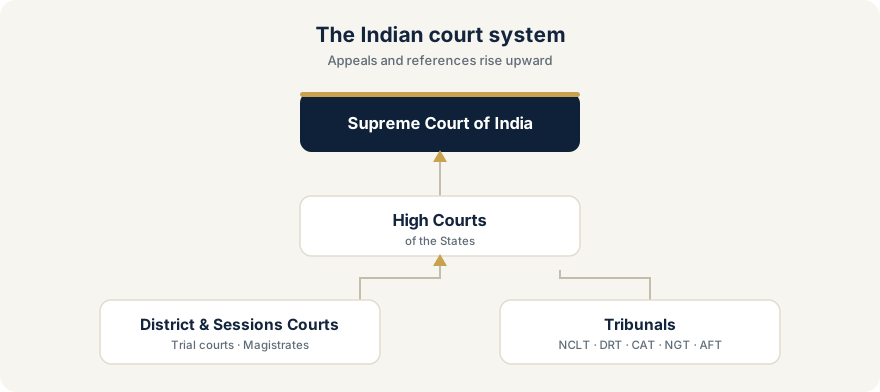
The firm appears for the defence and, where instructed, for complainants, before the Magistrates' and Sessions Courts of Delhi, the Delhi High Court and the Supreme Court. Adv. Neeraj Kumar Garg's background in information technology (BSc IT and MCA) alongside the law is put to direct use where a case turns on call records, devices, bank trails or CCTV, areas that increasingly decide modern criminal trials.

The new criminal codes: BNS, BNSS and BSA
The substantive offences continue with new numbering. Murder is now punishable under Section 103 of the Bharatiya Nyaya Sanhita (formerly Section 302 IPC) and culpable homicide not amounting to murder under Section 105 (formerly Section 304). Cheating that induces delivery of property is now Section 318, criminal breach of trust is Section 316, forgery is Section 336 and criminal conspiracy is Section 61. Cruelty to a wife by her husband or his relatives is Sections 85 and 86, and dowry death is Section 80.
The procedure that governs an investigation and trial is now in the BNSS, and the rules of evidence in the BSA. Knowing the correct provision, and whether the old or the new code applies to a given matter, is the first practical question in any current criminal case.
FIR, investigation and arrest
A first information report in a cognizable case is registered under Section 173 of the BNSS. The new code formalises the Zero FIR (registration at any police station regardless of jurisdiction) and provides for electronic registration and audio-video recording at several stages of an investigation. For offences carrying three to seven years, a preliminary enquiry is permitted before registration in some circumstances.
Arrest is not automatic. In Arnesh Kumar v. State of Bihar the Supreme Court directed that, for offences punishable with imprisonment of under seven years, the police must not arrest as a matter of course; they must apply the statutory checklist and ordinarily serve a notice of appearance first, and a magistrate must record satisfaction before authorising detention. These safeguards, originally framed around Sections 41 and 41A of the old Code, carry forward under the corresponding provisions of the BNSS. The firm acts at the earliest stage, on the response to a notice, the grounds of arrest and the first remand, where the direction of a case is often set.
Bail: anticipatory, regular and default
Anticipatory bail, a direction that a person be released on bail in the event of arrest, is sought under Section 482 of the BNSS (formerly Section 438 CrPC). After arrest, regular bail in a non-bailable offence is sought under Section 480, and the wider powers of the Sessions Court and the High Court are exercised under Section 483. Where the investigating agency fails to file its report within the statutory period (ordinarily sixty or ninety days depending on the gravity of the offence), the accused is entitled to default or statutory bail under Section 187.
The governing principle remains that bail is the rule and jail the exception. In Satender Kumar Antil v. CBI the Supreme Court grouped offences into categories and laid down directions to prevent unnecessary arrest and to ensure bail applications are decided quickly. Even in serious economic matters, the Court held in Sanjay Chandra v. CBI that detention before conviction is not to be used as a punishment, and that the seriousness of a charge does not by itself justify keeping a person in custody through a long trial.
Quashing of FIRs and criminal proceedings
Where a complaint is an abuse of the process of law or discloses no offence, the High Court can quash the FIR or the proceedings in the exercise of its inherent jurisdiction under Section 528 of the BNSS (formerly Section 482 CrPC). The categories in which this power is exercised were set out by the Supreme Court in State of Haryana v. Bhajan Lal, which remains the standard reference, and the High Court can also quash a matter that the parties have genuinely settled.
A petition to quash succeeds on a careful reading of the FIR and the material, not on rhetoric. The firm prepares these petitions on the documents, identifying precisely why the allegations do not make out the offence charged.
Trial, evidence and the digital record
Electronic evidence, messages, call detail records, server and device data, CCTV and financial records, is now governed by Section 63 of the Bharatiya Sakshya Adhiniyam (the successor to Section 65B of the Evidence Act), which requires a certificate and, in the BSA, more rigorous certification of how the record was produced. Much of the contest in a modern trial is over whether such evidence was lawfully collected, properly certified and not altered.
This is where the firm's technology background is directly useful. The work includes testing the chain of custody of a seized device, checking hash values and metadata, reading call records correctly, and exposing gaps between what a record actually shows and what the prosecution says it shows. The same scrutiny is applied whether the firm is defending an accused or supporting a complainant.
The legal framework
The principal statutes and the provisions that most often decide these matters. Statute text can be read in the firm's Legal Library; always check the current version at the official source.
Bharatiya Nyaya Sanhita, 2023 · Act 45 of 2023
- Section 103 — punishment for murder (formerly Section 302 IPC).
- Section 105 — culpable homicide not amounting to murder (formerly Section 304 IPC).
- Sections 316, 318 — criminal breach of trust and cheating (formerly Sections 406/409 and 415–420 IPC).
- Sections 61, 336 — criminal conspiracy and forgery.
- Sections 85–86 — cruelty to a wife by husband or relatives (formerly Section 498A IPC).
Bharatiya Nagarik Suraksha Sanhita, 2023 · Act 46 of 2023
- Section 173 — registration of the FIR, including the Zero FIR and electronic registration.
- Section 187 — police and judicial custody; the basis of default or statutory bail.
- Sections 480, 482, 483 — regular bail, anticipatory bail, and the bail powers of the Sessions Court and High Court.
- Section 528 — inherent powers of the High Court, used to quash FIRs and proceedings.
Bharatiya Sakshya Adhiniyam, 2023 · Act 47 of 2023
- Section 63 — admissibility of electronic records and the certificate required to prove them (formerly Section 65B of the Evidence Act).
Key judgments
Grouped by issue. Each case is cited from the court's own record; open a heading to read it.
Arrest 1
Arnesh Kumar v. State of Bihar Supreme Court
(2014) 8 SCC 273
For offences punishable with imprisonment of under seven years there is to be no automatic arrest. The police must apply the statutory checklist and ordinarily serve a notice of appearance; the magistrate must record satisfaction before authorising detention.
Bail 2
Satender Kumar Antil v. CBI Supreme Court
(2022) 10 SCC 51
Restating that bail is the rule and jail the exception, the Court grouped offences into categories and issued directions to curb unnecessary arrest and to ensure bail and anticipatory-bail applications are decided within fixed timelines.
Sanjay Chandra v. CBI Supreme Court
(2012) 1 SCC 40
The purpose of bail is to secure attendance at trial, not to punish before conviction. Even in serious economic offences, the gravity of the charge alone does not justify prolonged pre-trial detention.
Quashing of FIRs 1
State of Haryana v. Bhajan Lal Supreme Court
1992 Supp (1) SCC 335
Set out the categories of case in which a High Court may quash an FIR or criminal proceedings in the exercise of its inherent power, including where the allegations, taken at their highest, do not make out the offence alleged.
How we work on these matters
One advocate remains responsible for the matter, from the police station and the bail application through to the trial and any appeal, so the strategy stays consistent and the client always has a single point of contact.
Criminal defence is built on the record: the FIR, the case diary, the seizure memos, the electronic evidence and the statements. The firm reads the prosecution file closely and tests each link rather than relying on general submissions.
Advice on bail and on the likely course of a trial is given candidly, including where the prospects are difficult. The firm does not promise outcomes that the law and the evidence do not support.
Frequently asked questions
Do the new criminal codes apply to my existing case?
It depends on the date. Offences registered before 01.07.2024 continue to be investigated and tried under the old codes (IPC, CrPC and the Evidence Act); matters registered on or after that date proceed under the BNS, BNSS and BSA. Many cases now run in parallel under both regimes, which makes the choice of the correct provision important.
How soon can anticipatory bail be sought?
An application for anticipatory bail under Section 482 of the BNSS can be moved as soon as there is a reasonable apprehension of arrest in a non-bailable offence, often before or shortly after an FIR is registered. Early advice matters, because the response to a notice of appearance and the first hearing can shape the whole case.
What is default bail?
If the investigating agency does not complete its investigation and file the report within the period allowed by Section 187 of the BNSS (ordinarily sixty days, or ninety for graver offences), the accused becomes entitled to be released on default or statutory bail, provided the right is claimed and a bond furnished before the report is filed.
Can an FIR be quashed?
Yes, in appropriate cases. Under Section 528 of the BNSS the High Court can quash an FIR or proceedings that are an abuse of process or that do not disclose an offence, applying the categories laid down in State of Haryana v. Bhajan Lal. The court can also quash a matter that the parties have genuinely settled.
Is a WhatsApp message or CCTV clip admissible evidence?
Electronic records are admissible under Section 63 of the Bharatiya Sakshya Adhiniyam, but only if accompanied by the required certificate and shown to have been produced and preserved properly. Whether the certification is valid and the record unaltered is often a central question, and one the firm examines closely.
This note is general information on the law as at Jun 2026, not legal advice on any specific matter. The law changes; for advice on your facts, please speak to the firm.
Tell us about your matter.
Share the facts and we will tell you, candidly, where you stand and how we can help.