
Family & Personal
Family and Matrimonial Law
Divorce, maintenance, child custody, domestic violence and matrimonial cruelty, handled with discretion and a careful reading of the record.

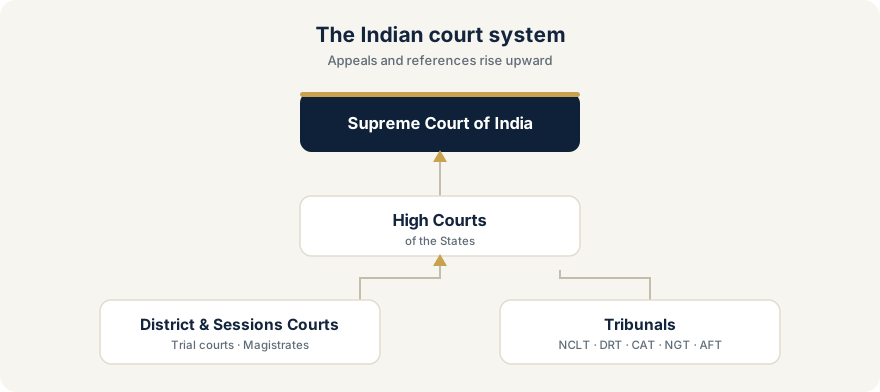
Matrimonial disputes turn on facts, dates and documents far more than on broad statements of law. Income, the dates parties lived together and apart, what was paid and promised, who holds the bank records and the messages: these decide an interim-maintenance application or a custody hearing. The firm advises individuals on the full range of family matters, from divorce and maintenance to child custody, domestic violence and the criminal side of matrimonial cruelty, before the family courts of Delhi, the District Courts, the Delhi High Court and the Supreme Court of India.
The approach is plain and candid. Where a negotiated settlement or mutual-consent divorce serves the client, that is said clearly and pursued; where the matter must be contested, it is prepared and argued on the record. The same standard of preparation goes into a family-court interim application as into an appeal.

Divorce: contested and by mutual consent
For Hindus, Buddhists, Jains and Sikhs, marriage and divorce are governed by the Hindu Marriage Act, 1955. A contested divorce under Section 13 must be founded on a statutory ground, including cruelty, desertion for two years or more, adultery, conversion, or mental disorder. A divorce by mutual consent under Section 13B requires that the parties have lived separately for at least one year and have freely agreed to dissolve the marriage.
Section 13B(2) prescribes a waiting period of six months (extendable to eighteen) between the first and second motions. The Supreme Court has held that this period is directory, not mandatory: in Amardeep Singh v. Harveen Kaur it ruled that a family court may waive the wait where there is no possibility of the parties resuming cohabitation and the issues of maintenance, custody and property are settled. The Supreme Court itself can go further and dissolve a marriage that has irretrievably broken down, exercising its power under Article 142 of the Constitution, as the Constitution Bench confirmed in Shilpa Sailesh v. Varun Sreenivasan.
Inter-faith and civil marriages are solemnised and dissolved under the Special Marriage Act, 1954, which requires a thirty-day public notice and provides for divorce on fault grounds and by mutual consent. Christians, Parsis and Muslims are governed by their own statutes and personal law. Choosing the right forum and the right ground at the outset avoids years of correction later.
Maintenance and alimony
A spouse who cannot maintain themselves can seek maintenance through several routes that often run in parallel: interim and permanent maintenance under Sections 24 and 25 of the Hindu Marriage Act, a wife's maintenance under Section 18 of the Hindu Adoptions and Maintenance Act, 1956, monetary relief under the Protection of Women from Domestic Violence Act, and the secular, religion-neutral remedy under Section 144 of the Bharatiya Nagarik Suraksha Sanhita, 2023 (which replaced Section 125 of the Code of Criminal Procedure from 01.07.2024).
In Rajnesh v. Neha the Supreme Court laid down binding guidelines to bring order to these overlapping claims. Both parties must file a sworn Affidavit of Disclosure of Assets and Liabilities; maintenance is ordinarily payable from the date of the application, not the date of the order; and a court setting maintenance in one proceeding must account for what has been awarded in another, so the payer is not made to pay twice over for the same period.
The remedy under Section 144 BNSS is available regardless of religion. In Mohd. Abdul Samad v. State of Telangana (2024) the Supreme Court confirmed that a divorced Muslim woman may claim maintenance under this secular provision, which stands in addition to her rights under the Muslim Women (Protection of Rights on Divorce) Act, 1986, not in derogation of them.
Cruelty, Section 498A and dowry
Cruelty by a husband or his relatives is now an offence under Sections 85 and 86 of the Bharatiya Nyaya Sanhita, 2023, which carry forward the old Section 498A of the Indian Penal Code with substantially the same language and punishment (imprisonment up to three years and fine). Section 86 separately defines cruelty to include conduct likely to drive a woman to suicide or to grave injury, and harassment to coerce an unlawful demand for property. The offence is cognizable, non-bailable and non-compoundable. Giving or taking dowry, and demanding it, remain punishable under Sections 3 and 4 of the Dowry Prohibition Act, 1961.
These provisions protect genuine victims, and the courts have also built in safeguards against their misuse. In Arnesh Kumar v. State of Bihar the Supreme Court directed that there be no automatic arrest in offences punishable with under seven years' imprisonment; the police must first apply the checklist in Section 41 of the Code and ordinarily issue a notice of appearance under Section 41A before any arrest. Where a matrimonial criminal case is genuinely settled, the High Court may quash the proceedings in the exercise of its inherent jurisdiction. The firm acts for complainants and for those accused, and in both cases the work is the same: establish the facts on the record, early and accurately.
Domestic violence: protection under the PWDVA
The Protection of Women from Domestic Violence Act, 2005 is a civil law with real teeth. An aggrieved woman applies to the Magistrate under Section 12 and can obtain a protection order restraining further violence (Section 18), a residence order securing her right to remain in the shared household (Section 19), monetary relief for expenses and losses (Section 20), custody of children (Section 21) and compensation (Section 22). Breach of a protection order is itself a criminal offence under Section 31.
Because relief under this Act is quick and does not depend on first proving a criminal case to the hilt, it is often the most effective immediate remedy. The firm advises on securing interim protection and residence orders without delay, and on resisting applications that are not made in good faith.
Child custody and guardianship
In every custody dispute the governing principle is the same: the welfare of the child is the paramount consideration, and it overrides the otherwise legal claims of either parent. The Supreme Court has restated this in Yashita Sahu v. State of Rajasthan and Gaurav Nagpal v. Sumedha Nagpal. Custody and guardianship are decided under the Hindu Minority and Guardianship Act, 1956, the Guardians and Wards Act, 1890, and Section 26 of the Hindu Marriage Act in a pending matrimonial case.
Courts increasingly recognise that a child usually benefits from a continuing relationship with both parents. The firm's work in these matters is to present a clear, honest picture of the child's actual circumstances, schooling, care and stability, and to negotiate workable custody and visitation arrangements, litigating only what genuinely needs to be litigated.
The legal framework
The principal statutes and the provisions that most often decide these matters. Statute text can be read in the firm's Legal Library; always check the current version at the official source.
Hindu Marriage Act, 1955 · Act 25 of 1955
- Section 13 — grounds for a contested divorce (cruelty, desertion, adultery, conversion and others).
- Section 13B — divorce by mutual consent; first and second motions with a statutory waiting period.
- Section 9 — restitution of conjugal rights.
- Sections 24–25 — maintenance pendente lite and permanent alimony.
- Section 26 — custody, maintenance and education of children in a pending matter.
Special Marriage Act, 1954 · Act 43 of 1954
- Sections 4–13 — civil and inter-faith marriage, with a thirty-day notice and registration.
- Sections 27–28 — divorce on fault grounds and by mutual consent.
Protection of Women from Domestic Violence Act, 2005 · Act 43 of 2005
- Section 12 — application to the Magistrate for reliefs.
- Sections 18–22 — protection, residence, monetary relief, custody and compensation orders.
- Section 31 — breach of a protection order is a punishable offence.
Bharatiya Nyaya Sanhita, 2023 · Act 45 of 2023
- Sections 85–86 — cruelty by a husband or his relatives (replacing Section 498A IPC from 01.07.2024); Section 86 defines cruelty.
Bharatiya Nagarik Suraksha Sanhita, 2023 · Act 46 of 2023
- Section 144 — maintenance of wives, children and parents (the secular remedy that replaced Section 125 CrPC).
Hindu Adoptions and Maintenance Act, 1956 · Dowry Prohibition Act, 1961
- Section 18, HAMA — a Hindu wife's right to be maintained by her husband.
- Sections 3–4, Dowry Prohibition Act — penalties for giving, taking or demanding dowry.
Key judgments
Grouped by issue. Each case is cited from the court's own record; open a heading to read it.
Divorce & irretrievable breakdown 2
Shilpa Sailesh v. Varun Sreenivasan Supreme Court
2023 INSC 468 · (2023) 4 SCC 692
The Supreme Court can dissolve a marriage that has irretrievably broken down by exercising its power under Article 142, and can waive the six-month waiting period under Section 13B(2) of the Hindu Marriage Act, a power to be used with care after weighing the length of separation and the failure of reconciliation.
Amardeep Singh v. Harveen Kaur Supreme Court
(2017) 8 SCC 746
The six-month waiting period in Section 13B(2) is directory, not mandatory. A court may waive it where the marriage is beyond repair and the parties have settled maintenance, custody and property.
Maintenance 2
Rajnesh v. Neha Supreme Court
(2021) 2 SCC 324
Binding guidelines on maintenance: a sworn Affidavit of Disclosure of Assets and Liabilities by both sides, maintenance ordinarily from the date of application, and one court accounting for maintenance awarded in another so the payer is not made to pay twice.
Mohd. Abdul Samad v. State of Telangana Supreme Court
2024 INSC 506
A divorced Muslim woman may seek maintenance under the secular provision (then Section 125 CrPC, now Section 144 BNSS); that right is in addition to the Muslim Women (Protection of Rights on Divorce) Act, 1986, not in derogation of it.
Cruelty & Section 498A 1
Arnesh Kumar v. State of Bihar Supreme Court
(2014) 8 SCC 273
No automatic arrest in offences punishable with under seven years (including matrimonial cruelty). Police must apply the Section 41 checklist and ordinarily serve a Section 41A notice of appearance first; magistrates must record satisfaction before authorising detention.
Child custody 1
Yashita Sahu v. State of Rajasthan Supreme Court
(2020) 3 SCC 67
In custody matters the welfare of the child is the paramount consideration, and the parent denied custody is ordinarily entitled to meaningful visitation and contact.
How we work on these matters
One advocate stays responsible for the matter from the first conference to the final order, so the client always knows who is handling their case and the strategy stays consistent.
Family matters are won or lost on the record. The firm builds the file early: income and asset documents, dates of cohabitation and separation, communications and medical or police records, so that an interim-maintenance or custody application is supported by evidence rather than assertion.
Advice is candid about what the law allows and what it does not. Where a settlement or mutual-consent divorce is in the client's interest, that is pursued; where the matter must be contested, it is argued on the facts. The firm acts for spouses on both sides of these disputes.
Frequently asked questions
How long does a mutual-consent divorce take?
Section 13B of the Hindu Marriage Act builds in a waiting period of six to eighteen months between the two motions. That period can be waived in a deserving case: a family court may do so following Amardeep Singh v. Harveen Kaur, and the Supreme Court can dissolve a broken-down marriage at once under Article 142, as in Shilpa Sailesh. The realistic timeline depends on the court and whether maintenance, custody and property are already settled.
Who can claim maintenance, and from when?
A wife (including, in many cases, a divorced wife), children and dependent parents can claim maintenance under Section 144 of the BNSS, and a spouse can claim it under the Hindu Marriage Act and allied laws. Under Rajnesh v. Neha, maintenance is ordinarily payable from the date of the application, and both parties must file an Affidavit of Disclosure of Assets and Liabilities.
Is a Section 498A / Section 85 BNS complaint bailable?
Matrimonial cruelty under Sections 85–86 of the Bharatiya Nyaya Sanhita (formerly Section 498A IPC) is cognizable and non-bailable. However, under Arnesh Kumar v. State of Bihar there is to be no automatic arrest; the police must follow the Section 41 checklist and ordinarily issue a notice of appearance under Section 41A first.
Can a Section 498A case be settled and closed?
The offence is non-compoundable, but where the parties have genuinely resolved their disputes, the High Court can quash the proceedings in the exercise of its inherent jurisdiction. This is commonly done as part of a comprehensive matrimonial settlement.
How does a court decide child custody?
The single governing test is the welfare of the child, which the Supreme Court has held overrides the legal claims of either parent (Yashita Sahu, Gaurav Nagpal). Custody and guardianship are decided under the Hindu Minority and Guardianship Act, the Guardians and Wards Act, and Section 26 of the Hindu Marriage Act in a pending matrimonial case.
We married in different faiths. Which law applies?
An inter-faith or civil marriage is usually solemnised under the Special Marriage Act, 1954, which also governs its dissolution. The choice of statute affects the grounds, the procedure and the maintenance and succession consequences, so it is worth taking advice before the marriage as well as at the point of dispute.
This note is general information on the law as at Jun 2026, not legal advice on any specific matter. The law changes; for advice on your facts, please speak to the firm.
Tell us about your matter.
Share the facts and we will tell you, candidly, where you stand and how we can help.